

Outlets or plugs: which to choose when traveling so you don't run out of battery
You've got your tickets, passport, first-day outfit, and even your flight playlist ready. But there's one question many people leave for last: will I be able to charge my devices as soon as I arrive? 🔋 Because yes, you can survive without unpacking your suitcase on the first day, but arriving with your phone at 2% and discovering that the hotel's outlet looks nothing like yours... that can ruin any trip from the start.
The good news is that understanding this topic isn't as complicated as it seems. You just need to be clear on three things: the type of plug, the voltage, and the frequency. With that sorted, you avoid buying unnecessary accessories, damaging a device by plugging it in where it shouldn't be, or ending up frantically paying for an improvised adapter at your destination. ✈️
What will you find in this blog? 🧭
- Adapter is not the same as converter 🔌
- If you're traveling from Colombia, this quick map will save you 🌍
- So, what plug or adapter should you buy? 🛒
- And where to buy them in Colombia? 🇨🇴
- The hack that actually works when you travel 💡
- Be very careful when charging in public USB ports ⚠️
- It's not all about the plug: you also need connection as soon as you land 📱
🔌 First things first: an adapter is not the same as a converter
This is the most common confusion. An adapter only changes the shape of the plug so that your charger can fit into the wall outlet of the country you're visiting. It does not change the voltage of the power. In contrast, a voltage converter does transform the current so that a device designed for 110V can work in a place where the grid operates at 220V, or vice versa. A universal adapter provides physical compatibility, but it does not replace a voltage converter.
So, what do most travelers need? In reality, much less than they think. Most modern chargers for cell phones, laptops, tablets, cameras, or watches have something like “Input: 100-240V, 50/60Hz” on their label. When you see that, you can breathe easy: it means that charger is multi-voltage and, in most cases, you only need a plug adapter.
What should you be careful with? Devices that generate heat or use a motor: hair dryers, hair straighteners, old shavers, small fans, or some electric toothbrushes. In these cases, it's not enough for it to "fit." If the device doesn't support the local voltage, you can burn it out in seconds. And if it also operates at a different frequency, it might perform strangely or work under strain.
🌍 If you're traveling from Colombia, this quick map will save you
🟢 No adapter needed
Countries where the plug is the same or compatible with Colombia.
Your chargers usually work, but it's still worth checking the voltage if you're going to connect more delicate or heat-generating devices.
Like Colombia
Types A and B

Type A
Mainly used in the United States, Canada, and Mexico.

Type B
Common in North America and compatible with ground connection.
🟡 Adapter needed
Countries where the plug changes.
Your cell phone and computer chargers will usually work fine, but they won't fit directly into the wall socket.
European, British, or Australian plug
Types C, E, F, G, I, and others depending on the country

Type C
Used in: Europe and South America.

Type E
Used in: France, Belgium, and Poland.

Type F
Used in: Germany, Spain, and Portugal.

Type G
Used in: United Kingdom and Ireland.

Type I
Used in: Australia and New Zealand.
🔴 Beware of voltage
Here you must check carefully before connecting.
You may need an adapter and also check very carefully if your device supports 220V or 230V.
The greatest risk is not usually with the phone charger, but with hair dryers and straighteners.
🟣 Special cases
There are countries that don't easily fit into a single rule and should be checked before traveling.

Brazil
Uses different plugs and also the voltage varies by city or region. In some places you will find 127V and in others 220V.

Japan
Although it uses plugs compatible with Colombia, it operates at 100V, so it's worth checking sensitive or heat-generating devices.

India / South Africa
Have less common plugs, so a basic universal adapter may not always be sufficient.
If your destination falls into this category, don't improvise: check before connecting.
Special case
Brazil, Japan, India, South Africa
Type A
Used in: Japan.
Type B
Used in: Japan.
Type C
Used in: Brazil and India.

Type N
Used in: Brazil.
Hair dryers, straighteners, curling irons, and other heat-generating devices can be easily damaged in countries with different voltages than Colombia.
If in doubt, it's best not to connect them.
🛒 So, what plug or adapter should you buy?
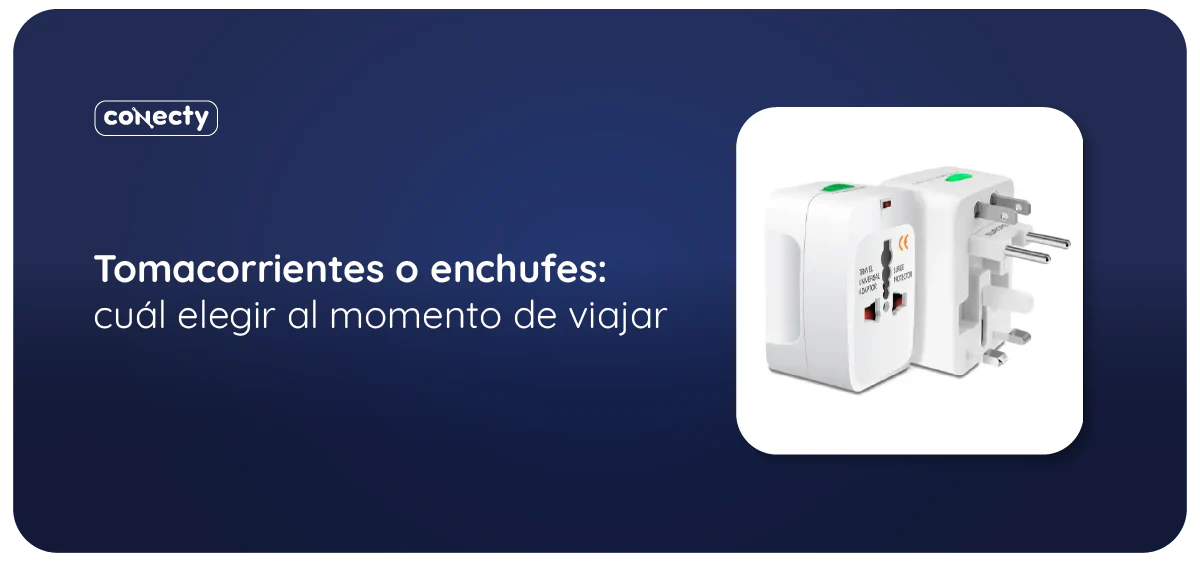
If you're making a one-time trip to a single country, you can just buy the specific adapter. But if you're someone who plans routes with friends, has layovers, or takes every opportunity to cross borders, a universal adapter is definitely worth it. The best models today usually cover A, C, G, and I, include USB or USB-C ports, and add protections like a fuse or safety shutters. Among the most recommended devices by specialized media are options from Epicka, Ceptics, BESTEK, Anker, and TESSAN, but be aware: not all of them cover India or South Africa.
Here's an important tip: don't buy the first one you see just because it "works for everything." In the United Kingdom, for example, authorities have issued safety alerts about unsafe adapters due to risk of electric shock. It's also recommended to look for recognized brands and visible certifications on chargers and electrical accessories. In short: it's better to buy well once than to risk your phone, laptop, or, worse, your safety.
And where to buy them in Colombia?
Before you travel, in Colombia, you have easy options. At Conecty, you can find universal adapters on our website or through our WhatsApp line, so you can sort out this detail before taking off. However, it's important to remember that an adapter does not convert voltage; it only allows you to plug your devices into outlets with a different shape.
💡 The hack that actually works when you travel
If you're traveling with your phone, camera, smartwatch, headphones, and power bank, there's a simple trick that saves space and headaches: bring a small power strip from Colombia.
This way, you only plug one universal adapter into the wall, and from there, you can power several of your chargers at once. However, only do this with multi-voltage devices.
The power strip does not convert voltage; it just gives you more outlets.
⚠️ Be very careful when charging in public USB ports
It might seem convenient to plug your cable directly into a public USB port at the airport, hotel lobby, or a train station, but it's not always the safest option. The CISA, the cybersecurity agency of the U.S. government, recommends not charging your device in a public USB port without a data blocker, because these ports can be manipulated to expose device information. The safest option is still to use your own charger connected to a traditional outlet, or a reliable power bank.
📱 It's not all about the plug: you also need connection as soon as you land
Being able to charge your devices is key, yes. But something just as important is having internet as soon as you arrive. Because as soon as you land, you need to check your accommodation reservation, request transportation, let people know you arrived safely, or find your way on the map without relying on airport Wi-Fi.
Therefore, in addition to checking what adapter you need for your destination, it's worth leaving Colombia with your connectivity sorted. With Conecty's international eSIM, you can be connected from the very first moment, without searching for physical SIM cards, without queues, and without starting your trip rushing after a Wi-Fi network.
Because in the end, traveling prepared isn't just about knowing what plug to use, but making sure your phone actually responds when you need it most. ✨


