

The 2026 World Cup has already started: how to get between venues without travel eating into the football
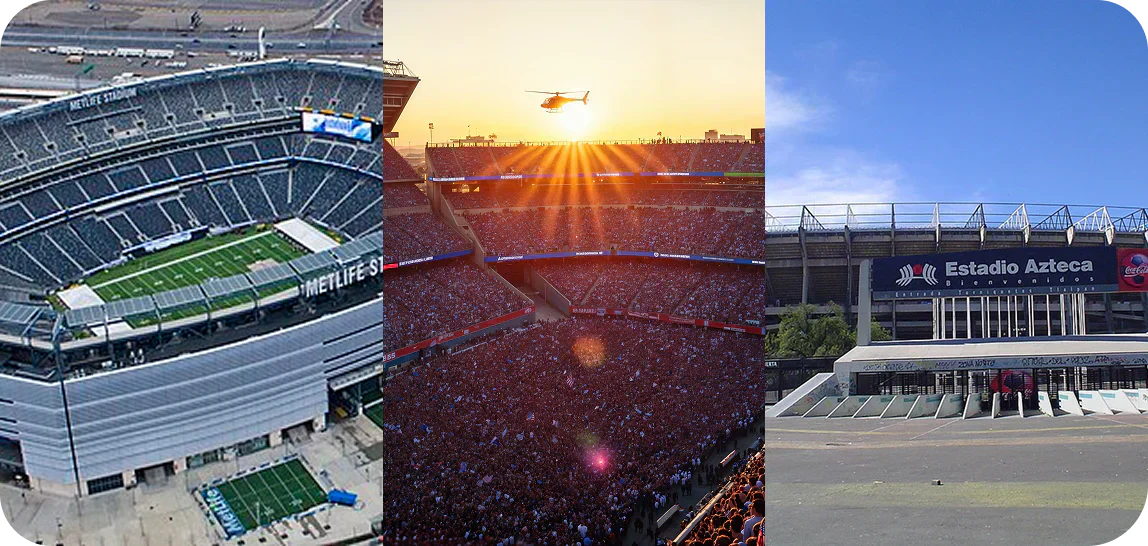
⚽ It has begun. Estadio Azteca has just opened its doors for the inauguration of the 2026 World Cup, officially kicking off the biggest tournament in football history: 48 teams, 3 countries, 16 venues, and 104 matches spread across the continent.
📍 What you'll find in this blog
- ⚽ First, a thrilling fact to kick things off
- 🗺️ The key to getting around: the World Cup is traveled by zones, not end-to-end
- 🚆 How to get around by zone: the simple rule
- 🏟️ Worthwhile facts about each venue
- 🍁 Canada: Toronto and Vancouver aren't planned the same way
- ✈️ Key routes between venues
- 🎟️ Where do you buy tickets?
- 🏙️ The best base city according to your travel style
- 📅 A possible 14-day itinerary
- 📶 Get connected right from the start
- ✨ Tips to enjoy more and rush less
🌎 And if you're reading this thinking about how to get in on the trip—or you already have something planned and want to optimize it—this blog is for you.
✈️ Because getting around in this World Cup isn't like previous ones. It's not one city, it's not one country. There are thousands of kilometers between venues, and if you don't plan well, you could end up spending more time in airports than in stadiums. Here's how to avoid that. 🏟️
⚽ First, a thrilling fact to kick things off
The Azteca made history this June 11th. It became the only stadium in the world to host three World Cups — 1970, 1986, and now 2026. Not a single other stadium on the planet can say the same.
But there's more: Mexico is also the country that has inaugurated a World Cup the most times. It did so in the first tournament in history, in 1930, and repeated it today at the Azteca. And as if that weren't enough, this match between Mexico and South Africa repeats the same opening clash from the 2010 World Cup — that time in Johannesburg, with a Rafa Márquez who equalized the match in the 48th minute and made history.
All of that happened today, meters from Coyoacán, with almost 100,000 people in the stands and Shakira in the opening show.
🏆 A historic start
⚽ The 2026 World Cup is the biggest tournament in history.
🏟️ Estadio Azteca became the only stadium in the world to host three World Cups.
🇲🇽 Mexico was once again a protagonist in a World Cup inauguration.
🎤 Nearly 100,000 fans experienced the opening spectacle alongside Shakira's show.
🗺️ The key to getting around: the World Cup is traveled by zones, not end-to-end

This is the most important and least exciting advice, but the one that saves the most trips: don't plan your route as if all the venues were close. They are not.
For a trip of 10 to 14 days, the smartest thing is to choose two or three regions and move within them:
Northeast U.S. (Boston, New York/New Jersey, Philadelphia): the most comfortable area to travel without a car, especially by train.
🤠 Texas (Dallas and Houston): works well by bus, car, or short flight.
🌴 California (Los Angeles and Santa Clara/Bay Area): flying is usually the most efficient, although a car can turn the journey into an iconic road trip.
🌲 Pacific Northwest (Seattle and Vancouver): one of the best cross-border combinations of the tournament.
Mexico (Mexico City, Guadalajara, and Monterrey): ideal for setting up a route within the country before connecting north.
📍 Quick summary
✈️ The 2026 World Cup is played in 3 countries and 16 venues.
🗺️ The most efficient way is to choose two or three regions and concentrate your trip there.
🚆 The Northeast U.S. is the easiest zone to travel without a car.
🌎 Seattle and Vancouver form one of the best international combinations of the tournament.
🚆 How to get around by zone: the simple rule
There isn't a single answer, but there is a clear guide:
🚆 Northeast U.S.
Use the train.
The Boston–New York–Philadelphia corridor is one of the most comfortable in the world for car-free travel.
Between New York/New Jersey and Philadelphia, for example, the train can take about an hour and a half. You can sleep in one city and move to another for the match.
🚗 Texas
Consider bus or car.
Dallas and Houston are about four hours apart by road.
If you're traveling in a group, renting a car can be the best option for price and convenience.
✈️ Long distances
Fly.
For routes like Dallas–Seattle, Miami–New York, or Mexico City–Toronto, flying is the only sensible option.
In a World Cup, time is also budget.
🌲 Seattle–Vancouver
Train, bus, or car.
One of the most friendly cross-border routes of the tournament.
Just keep border crossing times in mind.
💡 Quick rule: train in the northeast, car or bus in Texas, plane for long distances, and ground transport between Seattle and Vancouver.
🏟️ Worthwhile facts about each venue
Each stadium has its own story. Here are some facts that enrich the trip:
Mexico City – Estadio Azteca
The "Colossus of Santa Úrsula" has a capacity for almost 100,000 people and is where Maradona scored the "Hand of God" in 1986.
Today, it is also the opening venue for 2026.
🚇 To get to the match: Metro Line 2 to Tasqueña station, then a "pesero," or Uber with extra time.
🌮 Near the stadium, the Coyoacán neighborhood is a must-stop for tacos and a relaxed afternoon.
Guadalajara – Estadio Akron
Known as the "Pearl of Jalisco", it is surrounded by an urban forest and has one of the best natural views of any stadium in the world.
🏛️ If you have time, Guadalajara's historic center and the Mercado San Juan de Dios are experiences you won't find at any other venue.
Monterrey – Estadio BBVA
The most modern stadium in Latin America, nicknamed the "Steel Giant".
⛰️ It is framed by Cerro de la Silla, giving it a unique postcard view from the stands.
Dallas – AT&T Stadium
It is the stadium with the most matches in the 2026 World Cup: nine in total.
📺 It has a giant screen suspended above the field — over 160 meters long — which is one of the largest in the world.
New York/New Jersey – MetLife Stadium
The venue for the grand final, on July 19.
🏟️ One of the largest stadiums in the tournament, with a capacity for over 82,000 people.
Los Angeles – SoFi Stadium
The most expensive stadium of all those to be used in this World Cup.
💰 It cost 5.5 billion dollars and has the largest 360° screen ever built.
Atlanta – Mercedes-Benz Stadium
It stands out for its retractable roof, which opens like a camera lens.
🎡 Near the stadium are the Georgia Aquarium and Centennial Park.
Vancouver – BC Place
Indoor stadium with a retractable dome in the heart of the city.
🏔️ Surrounded by mountains and with the Pacific in the background.
Toronto – BMO Field
It's in Liberty Village, with a bar and restaurant area perfect for pre-match festivities.
🚊 Public transport with the Presto card connects you from anywhere downtown.
🍁 Canada: Toronto and Vancouver aren't planned the same way
It's worth stating clearly:
🏔️ Vancouver
Vancouver pairs perfectly with Seattle.
The distance is manageable by land, and you can add a second country without taking a flight.
It's one of the best cross-border crossings of the tournament.
🏙️ Toronto
Toronto works better with a well-planned flight.
Traveling by land from New York is possible, but it's not short and involves a border crossing.
If you want Canada to be an important part of your trip, Toronto is very much worth it — but it needs its own space in the itinerary.
📍 Quick rule: Vancouver fits very well into a route with Seattle. Toronto works better as a specifically planned stop within the trip.
✈️ Key routes between venues
🗽 New York/New Jersey ↔ Philadelphia
Best option: Train
Where to search: Amtrak, NJ Transit, SEPTA
🏙️ Boston ↔ New York/New Jersey
Best option: Train or bus
Where to search: Amtrak, Greyhound, FlixBus
🌲 Seattle ↔ Vancouver
Best option: Train, bus or car
Where to search: Amtrak Cascades, FlixBus, Greyhound, Rentalcars
🍁 Toronto ↔ New York/New Jersey
Best option: Plane
Where to search: Air Canada, WestJet, United, Amtrak, Greyhound
🤠 Dallas ↔ Houston
Best option: Bus, car or short flight
Where to search: Greyhound, FlixBus, Southwest, Rentalcars
🌴 Los Angeles ↔ Santa Clara/Bay Area
Best option: Plane or car
Where to search: Google Flights, Alaska Airlines, Southwest, Rentalcars
🇲🇽 Mexico ↔ U.S. or Canada
Best option: Plane
Where to search: Aeroméxico, Volaris, Viva Aerobus, Air Canada, Google Flights
🎟️ Where do you buy tickets?
No need to overcomplicate things. These are the most useful platforms depending on the type of transport you need:
✈️ Flights
Google Flights, Skyscanner, Kayak or Hopper to compare.
Then check directly with American Airlines, Delta, United, Southwest, JetBlue, Alaska Airlines, Air Canada, WestJet, Aeroméxico, Volaris or Viva Aerobus.
🚆 Trains
Amtrak for the U.S. (especially the Northeast corridor and Seattle–Vancouver).
VIA Rail for routes in Canada.
🚌 Buses and cars
Greyhound, FlixBus, Megabus or Busbud for buses.
Rentalcars, Kayak, Expedia or directly with Hertz, Avis, Budget, Enterprise, National or Alamo to rent a car.
📍 Getting around the city
Google Maps, Apple Maps, Citymapper or Moovit for routes.
Uber and Lyft to get to the stadium, although on match days fares tend to increase quite a bit.
🗺️ Planning intercity routes
Rome2Rio and Omio show you combinations of plane, train, bus, and car in one place, which is very useful for comparing options between venues.
🏙️ The best base city according to your travel style
🚆 Don't want to rent a car?
Philadelphia is probably the best base. It's very well located in the Northeast, has good connections to New York and Boston, and is usually more manageable in terms of prices.
✈️ Want to cover several regions with flights?
Dallas has one of the country's most important airports, many internal connections, and is also the venue with the most matches in the 2026 World Cup.
🍁 Want to add Canada without complications?
Seattle is the best option for combining the United States and Canada within the same trip.
🏖️ Coming from Latin America and want beach + football?
Miami combines excellent air connections, a World Cup atmosphere, and many options to enjoy outside of matches.
🚇 Looking for the best urban transport experience?
New York/New Jersey offers one of the most comprehensive transport networks in the entire World Cup and allows for easy connection to other Northeast venues.
📅 A possible 14-day itinerary
🗽 Philadelphia and New York/New Jersey
Base in one city, moving by train. The easiest corridor of the tournament.
If you have a free afternoon in Philadelphia, Reading Terminal Market or the Fishtown neighborhood are a good break between matches.
🍁 Boston or Toronto
Head to Boston by train from New York, or fly to Toronto if you want to add Canada.
Kensington Market, Lake Ontario, and the city's multicultural atmosphere make Toronto worth its own chapter in the trip.
🤠 Dallas and Houston
Fly to Dallas and use it as your base.
If the schedule permits, head down to Houston by bus or car.
Playing at AT&T Stadium is a capital-letter stadium experience.
🌲 Seattle and Vancouver
Great finale: two venues, two countries, no plane.
Allow time for the border crossing and, if you can, dedicate a morning to the surroundings of Vancouver.
One of the most impressive landscapes of the entire trip.
📶 Get connected right from the start

On a trip with so many journeys, having internet is not a luxury: it's part of the logistics. You need data to check boarding gates, schedule changes, maps, routes to the stadium, digital tickets, reservations, and messages from your group.
That's where a Conecty eSIM makes your life easier. You activate it before you leave and arrive connected from the first moment, without depending on airport Wi-Fi or searching for a physical SIM in each country.
And when your route crosses the U.S., Mexico, and Canada, changing countries without data can turn any journey into unnecessary stress.
- ✈️ Data from the moment you land.
- 🗺️ Navigation to move between venues and cities.
- 🎟️ Access to tickets, reservations, and transportation apps.
- 🌎 Connectivity as you cross borders during the World Cup.
With Conecty, you stay connected between flights, trains, buses, borders, and stadiums. So you don't miss anything: not the journey, not the match, not the plan with your people. ⚽🌎
✨ Tips to enjoy more and rush less
Don't try to see it all
Don't try to visit all the venues in one trip. The World Cup is more enjoyable when you have time to walk around the city, sit down to eat unhurriedly, and experience the atmosphere between matches.
Pack light
Airports, stations, hotels, buses, and stadiums are much easier to manage when you don't carry more than necessary.
Book in advance
Key routes, well-located hotels, and flights between venues often sell out long before the most important matches.
If you visit Canada, check your documentation
When your itinerary crosses borders, it's a good idea to check immigration requirements before traveling to avoid surprises.
Don't connect a flight and a match with little margin
During a World Cup, everything takes longer: airports, transportation, and stadium access.
🌎 The best World Cup trip is not the one that accumulates the most cities, but the one that allows you to enjoy the matches, get to know each destination, and arrive at the stadium with energy.
Plan realistically, book in advance, and leave room for the trip to surprise you. Because in the end, the best memories often appear between one match and the next. ⚽✨

Autor:
Paula Duque
Paula Duque (also known as Maracuyá) is a Design Manager, photographer, and audiovisual producer, specializing in strategic storytelling applied to travel and experiences. Her approach begins with the territory and real-life experiences: she observes, asks questions, tests, and contrasts before recommending. She enjoys traveling beyond typical tourist routines, understanding the cultural roots and dynamics of the places she visits. She writes from lived travel experiences, not from brochures or tourist promises. Her writing is fresh and approachable, yet based on discernment, context, and utility. She combines narrative, imagery, and transmedia communication with practical information to help travelers make better decisions on their journeys: where to go, what to avoid, how to get around, what to order, when to arrive, and why it's worthwhile. For Paula, traveling is not just moving between points, but designing experiences with intention: connecting with stories, people, and decisions, and having the right information at the right time.


